Nigel Nicholson

Here you will find my thoughts, writing, podcasts and blogs - about Unique Individuality, evolutionary perspectives, family business and much more - including my own life story & career
WHO I AM
WHAT'S ON MY MIND
MY WORK
I look at current affairs through the joint lens of evolutionary science and unique individuality. It helps make sense of much nonsense going on around us.
October 23, 2026. I am trying to create a new interactive website, based on the ideas in my book, Unique You. Its aim will be to help you formulate narratives of identity and purpose, as we navigate a challengoing and chaning world. Do write to me if you would find this of interest and what you'd want from it. [email protected]
The 1970s in the UK (and elsewhere) was an era of industrial conflict. It saw unions at the height of their powers, which declined dramatically during the "Thatcher Revolution", a trend that has continued.I worked for around 7 years on the psychology of labour relations, at that time very much on the fringe of field dominated by labour economists. I published two books and many articles, including some of the most methologically challenging projects of my career - project spanning disciplines and levels of analysis - from the individual shop steward through to the union and host public or private employing organisation.
I am always willing to help individuals, groups and organisations where I can.This is always based upon two interlocking perspectives: 1. The evolutionary view of human nature - the motives and cognitive biases that explain much human behaviour, 2. The UI perspective - understanding individuals as persons with unique histories and self-concepts, whether as leaders or members of a collective.I use personality assessment and biographical analysis (my 4D Framework) to help people achieve mastery over their directions and fulfilment in their experience.Write to me at [email protected]
UI - Unique Individuality - has been central to my interest in psychology since my youth. Yet it was only in 2024, inspired by my mid-life Biography students on the Sloan Fellowship and their stories, that I realised that almost no scholars since Gordon Allport, nearly a 100 years ago, have taken it seriously. He called for an "ideographic psychology" - we are all exceptions!The implications are vast and far-reaching. I have tried to start filling this huge gap through my book, blogs, and public appearances.My book, Unique You (published by Hogan Press in 2026, is the first to take the topic of human unique individuality (UI) seriously. Written engagingly for a general readership, full of illustrative stories, it presents an analysis of how UI works in all areas of relationships, life and culture. Throughout it is informed by sound underpinnings in behaviour genetics, evolutionary science, neuroscience and individual differences psychology.The Press Release captures the key idea and list the chapter headings.
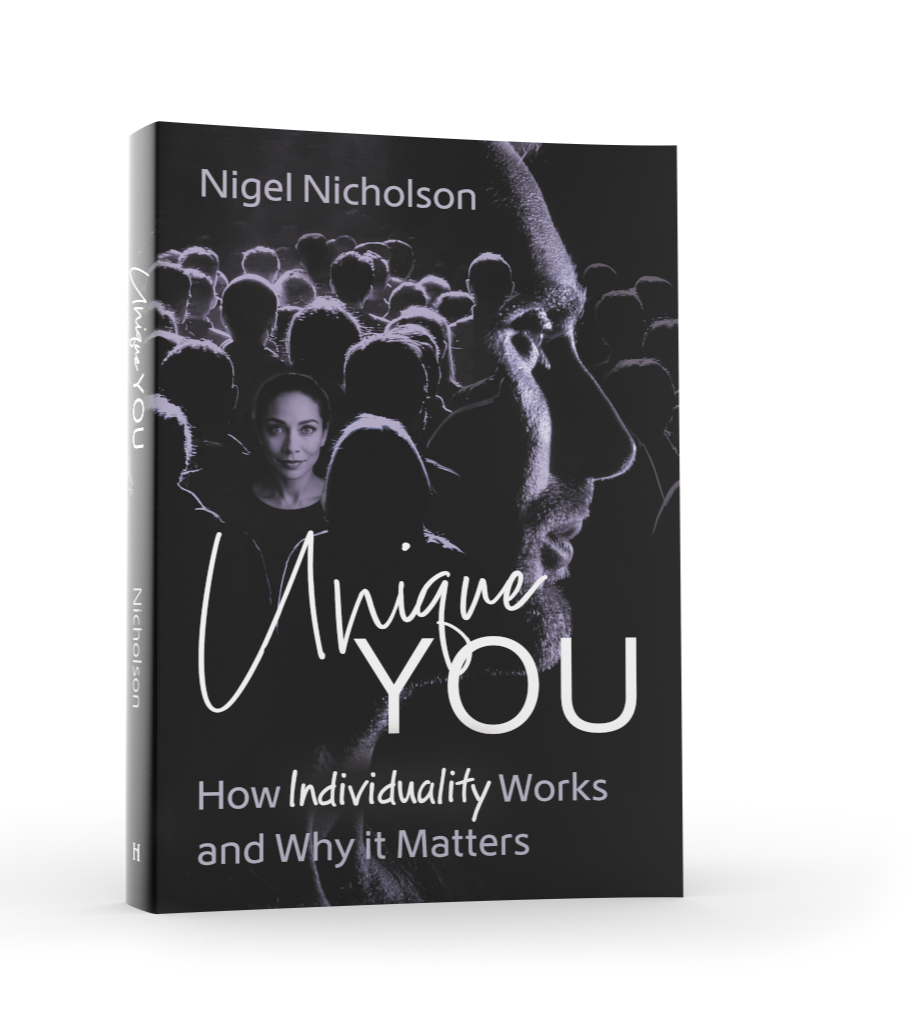
UNIQUE YOU: HOW INDIVIDUALITY WORKS AND WHY IT MATTERS
A book for our timesWe are told we are entering the age of AI (Artificial Intelligence), but it is equally true, no less important, yet largely unrecognised, that we are also entering the age of UI – Unique Individuality. Personalisation is already visible in many areas of life and will become a major theme in public and private life.This remarkable book, astonishingly first book in modern times to do so, provides a comprehensive analysis of what it means to be unique, as we all are, and to spell out its profound and far-reaching implications. Nigel Nicholson does so in a lively, readable style, in a book peppered with the extraordinary everyday stories of men and women from all over the world, as well as from history and literature.In the words of Patrick Dixon, eminent futurist:
Every now and then a book comes along which is radically different from anything published before and you know immediately will become a classic. "Unique You" is just that. It is a stunning and highly readable book which strikes to the heart of so many personal issues. The pages explode with life-enhancing insights and practical suggestions which will turbo-charge the next chapters of your life.The first chapters spell out what UI means. No-one like you has ever lived on this planet before, nor ever will again, yet how little we know ourselves and each other, and how necessary this makes it for us connect with people and understand their uniqueness.The book explains, clearly and simply, the science of individuality and how it plays out in families and relationships. The heart of the book is life stories, showing how only a biographical view of each other can fully make sense of what we do and how societies work.The book gives readers a simple framework to do this, exploring how it plays out in every area of experience. This includes crossing cultural boundaries, leadership, the arts and sciences, and the dark side of being human. The book concludes by showing how UI is our ultimate power tool for mastering technology in the age of AI, as well as the ethical implications of individuality.ContentsPreface/Introduction1. What It Means to be Unique – Why Individuality Matters
How a Uniqueness Perspective casts throws a fresh light on much of everyday life; introducing the 4-D model – a powerful analytical tool for coaches.
2. The Evolution of Individuality – From Destiny to Free Will
Busting the myths of family relationships how individuals can escape their false narratives
3. How Individuality Works – Beast-being, Ego and the Self
How personal narratives, which determine so much that happens to us, may be best tuned to the hidden and visible aspects of identity.
4. The UI2 of Relationships – The Connection Imperative
Love, friendship, and partnership all bring the uniqueness of every bond into play for good and for ill.
5. UI meets Culture – The Borders of Being
How can we find a home for our UI? For each person the search and the solution are different, including migration, building your own niche and self-control.
6. The UI Dark Side – Dealing with our Demons
We all have a dark side; the challenge differs for each of us, depending upon how reconciled we are to all aspects of our individuality
7. Life Stories – UI Transitioning and Transforming
Three periods of life, childhood, adolescence and midlife, are full of transforming processes, which we can manage and steer through with insight.
8. Uniqueness Transcendent – Art, Science and Self-actualisation
Not everyone can achieve greatness, but we can all discover what is the best expression of our UI.
9. Organising for Individuality – UI At Home in the World
How we organize and lead people can liberate or supress UI. What are their key design elements and how achievable are they?
10. Liberating UI - Strategies, Methods, Process
The Biography methodology, including all materials, are set out, including the key critical process of “decentering”.
11. UI meets AI In An Age of Anxiety
Rather than fearing technologies, we should pay attention to how people may misuse them, and how UI can be our last defence in the digital era.
12. The Ethics of Individuality
If we are entering a new age of UI, what does this mean for our ethical codes. It is not a recipe for selfishness, rather a plea for authentic connection.__
Nicholson, N. (2003). How to motivate your problem people. Harvard Business Review, Volume 81, January, 56-67.
a. Reprinted in: Harvard Business Review on Motivating People. Cambridge, MA: Harvard Business School Press, 2003.
b. Reprinted in HBR On Point: Be a Better Boss: How to bring out the best in your people. Fall, 2015, pp. 110-119.*Podcast from "The Why" series of interviews for London Business School alumni, hosted by Katie Pisa.]. June 2026*Podcast Hogan Assessments series on the Science of Personality. May 2026.* Short interview about leadership and UI with Gulf News, July 2026*Piece on leadership, UI and AI from Think, the London Business School's vehicle for thought leadership. July 2026AI meets UI: How humanity can succeed with technology. Critical Loop, September, 2026.
I have been working for over 30 years with family business. I was drawn to the field by my evolutionary interest in kinship ties and how they affect behaviour. This is nowhere more clearly apparent than in the family firm, where primal human social instincts collide or cooperate with the rational principles of business.The results of this interaction are varied, to say the least!
It all depends upon the Unique Family - the configuration of family size, age and gender, and the UIs - Unique Individualities - of its members.That's been my approach in family consulting - to reveal the architecture of the family's uniqueness and help it avoid the worst and achieve the best. The worst is the race to see which destroys the other first - the family or the business (see my book with Grant Gordon, Family Wars, or to achieve the best - the unique world-beating micro-cultures can can be built around the distinctive and inimitable qualities of the family and its values. (see articles)

Our best-selling book tells 24 unforgettable stories of famous family firm failures. Our reasoning was on the sound principle that you can learn more from failure than success, and besides, everyone loves a good horror story. We use the evolutionary framework set out in my academic papers to explain and interpret what is going on in these cases, and draw out the lessons for family firm effective governance, family dynamics and interventions.
My academic articles have focused on how evolutionary theory explains much that happens in family business, including why and how they can outperform and underperform compared to non-family firms.My work with Åsa Björnberg has focused on two major issues family firms – the emotional bond the next generation has with the firm, and, how to measure the main parameters of family “climate”. The two are linked, of course. The micro-culture of the unique family is directly implicated in how much emotional ownership exists in the next generation – the basis for the very future of the firm itself.Academic Papers (for a full list go to my CV). Bold highlighted titles are downloadable:Nicholson, N. (2015). Primal Business: Evolution, kinship and the family firm. In S.M. Colarelli, & R.A. Arvey. The Biological Foundations of Organizational Behavior. Chicago: University of Chicago Press.Nicholson, N. (2104). Evolutionary theory: A new synthesis for family business thought and research. In L. Melin, P. Sharma, & M. Nordqvist (Eds.). The SAGE Handbook of Family Business (pp. 119-136). Thousand Oaks, CA: Sage.Nicholson, N. (2008). Evolutionary psychology, corporate culture and family business. Academy of Management Perspectives, 22, 73-84.Björnberg, A., & Nicholson, N. (2007). The family climate scales: development of a new measure for use in family business research. Family Business Review, 20, 229-246.
26.Björnberg, A., & Nicholson, N. (2012). Emotional ownership: The next generation’s relationship with the family firm. Family Business Review, 25: 374-390.Practitioner Articles listed below plus a link to several columns written for a family business magazine (Family Business Perspectives):
Nicholson, N. (2008). Succession for Success. Business Executive.Nicholson, N. (2008). Blood ties. Management Today, March, 53-60.Family Business Perspectives. Very short articles on family business topics.
MY LIFE STORY
A work in progress! To read go HERE
Reading Robert Wright's "The Moral Animal" in 1995 changed my mind and my life in profound ways. I found what is now called the modern evolutionary synthesis compelling and profound, making a new integrated sense of all the work in my career, and indeed the whole field of psychology and beyond. That "beyond" embraces all social science, including politics and economics. It makes a new sense of history too, since culture follows the logic of evolution.It say less about individuality, hence my latest book Unique You.Here you will find listed some of my main publications you will find evolutionary thinking permeating all my writing on other topics since 1995. .
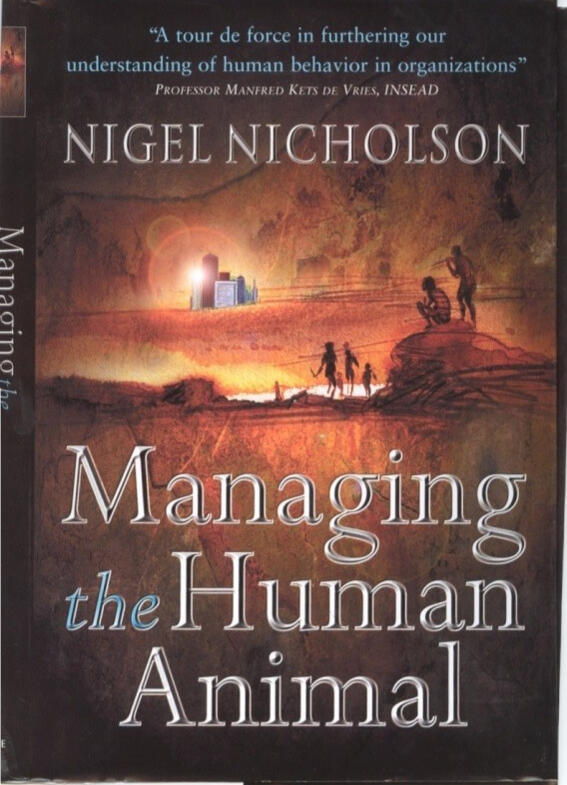
Immersing myself in evolutionary science from the mid '90s led to a much-cited article for Harvard Business Review, "How Hardwired is Human Behavior" and a book - Executive Instinct (Crown) in the USA, Managing the Human Animal in the UK (Texere).Listed here is a selection of the ones I consider most important, and some that are downloadable (highlighted in bold).
1. Nicholson, N. (2019). Nepotism. In Todd K. Shackelford and Viviana A. Weekes-Shackelford, (Eds.). Encyclopaedia of Evolutionary Psychological Science. New York: Springer.2. Duening. T., Nicholson, N., & Bradley-Geist, J. (2019). Evolutionary Awareness: Darwin among the organizational sciences. International Journal of Organization Theory & Behavior. Vol 22 (4), 297-312.3. Nicholson, N. (2015). Leadership as Adaptation: A critical review of the field. In D.M. Buss (Ed.), Handbook of Evolutionary Psychology Vol.2, 2nd Edition. New York: Wiley.4. Nicholson, N. (2015). Primal Business: Evolution, kinship and the family firm. In S.M. Colarelli, & R.A. Arvey. The Biological Foundations of Organizational Behavior. Chicago: University of Chicago Press.5. Nicholson, N., & White, R. (Eds.) (2006). Darwinian Perspectives on Organizational Behavior. Special Issue, Journal of Organizational Behavior, Vol. 27 (2).6. Spisak, B. R., O’Brien, M. J., Nicholson, N., & Van Vugt, M. (2015). Niche Construction and the evolution of leadership: Toward a unified theory. Academy of Management Review, 40:291-306.7. Nicholson, N. (2104). Evolutionary theory: A new synthesis for family business thought and research. In L. Melin, P. Sharma, & M. Nordqvist (Eds.). The SAGE Handbook of Family Business (pp. 119-136). Thousand Oaks, CA: Sage.8. Nicholson, N. (2012). The evolution of business and management. In S.C. Roberts (Ed.), Applied Evolutionary Psychology (pp16-35). Oxford: OUP.9. Spisak, B.R., Nicholson, N., & Van Vugt, M. (2011). Leadership in organizations: An evolutionary perspective. In G. Saad (Ed.), Applications of evolutionary psychology in the business sciences (pp. 165-190). Heidelberg: Springer.10. Nicholson, N. (2010). The design of work: An evolutionary perspective. Journal of Organizational Behavior, 31, 422-43111. Nicholson, N. (2008). Evolutionary psychology, corporate culture and family business. Academy of Management Perspectives, 22, 73-84.12. Nicholson, N. (2008). Evolutionary psychology and family business: A new synthesis for theory, research and practice. Family Business Review, 21: 103-118.13. Nicholson, N. (2005). Objections to evolutionary psychology: Reflections, implications and the leadership exemplar. Human Relations, 26: 137-154.14. Nicholson, N., & De Waal Andrews, W. (2005) Playing to win: Biological imperatives, self-regulation and trade-offs in the game of career success. Journal of Organizational Behavior, 26: 137-154.15. Nicholson, N. (2002). What stays the same. In Subir Chowdhury (Ed.) Organization 21C. New York: Financial Times & Prentice Hall.16. Nicholson, N. (2001). An evolutionary perspective on change and stability in personality, culture and organization. In M. Erez, U. Kleinbeck, & H. Thierry (eds.). Work Motivation in the Context of Globalizing Economy. Elsevier.17. Nicholson, N. (2001). The new word on gossip. Psychology Today. June, pp. 41-45.18. Nicholson, N. (2001). Gene politics and the natural selection of leadership. Leader to Leader. No.
20, Spring, pp. 46-52.19. Nicholson, N. (2000). Executive Instinct. New York: Crown Business Books. ([Managing the Human )](#animalbook. London: Texere – Paperback edition, 2004 Thomson Learning.)20. Nicholson, N. (1998). How hardwired is human behavior? Harvard Business Review, Vol. 76 (no.4, July/August), 134-147.21. Nicholson, N. (1998). Seven deadly syndromes of management and organization: The view from evolutionary psychology. Managerial and Decision Economics, Vol.19: 411-426.22. Nicholson, N. (1997). Evolutionary psychology: Toward a new view of human nature and organizational society. Human Relations, Vol.50, 1053-1078. (lead article).
General Interest
I have written on a wide range of topics, many of them journalistic commentaries of issues of the day through my personal viewfinder.
Here are some which may interest readers, including many publications on the field of transitions, an abiding theme throughout the latter part of my academic life. See my Life Story.1. Nicholson, N. (2020). The Adaptable Animal: Human nature through the pandemic……and Beyond. London Business School Webinar.2. Nicholson, N. (2017). 4 Leadership Takeaways from the UK general election. London Business School Review, June 2nd.3. Nicholson, N. (2012). Evolution meets the Olympics. Business Strategy Review, July, pp. 68-69.4. Nicholson, N. (2012). The Lure of Cities: London living. Business Strategy Review, August, pp. 38-39.5. Nicholson, N. (2010). The false theory of meritocracy. Harvard Business Review. June 1.6. Nicholson, N. (2010). Gender and the Future of the Hierarchical Organization. Harvard Business Review, June 7.7. Nicholson, N., Audia, P., & Pillutla, M. (Eds.). (2004) Encyclopedic Dictionary of Management: Organizational Behavior. 2nd Edition. Oxford: Blackwell.8. Nicholson, N. (1995) (Ed.) Encyclopedic Dictionary of Organizational Behavior. Oxford: Blackwell (paperback edition published in 1997).9. Nicholson, N. (1993). Organizational Change. In Christopher Mabey & Bill Mayon-White (Eds.), Managing Change. Paul Chapman Publishing Ltd., London.10. Nicholson, N., Brenner, S.O. (1994). "Dimensions of Perceived Organisational Performance - Tests of a Model" Applied Psychology: An International Review, 43, No.1, 89-108.Ethics & Wisdom1. Nicholson, N. (2007). The Getting of Wisdom: Self-conduct, personal identity and wisdom across the life-span. E.H. Kessler & J.R. Bailey, J.R. (eds.) 2007. Handbook of Organizational and Managerial Wisdom. (pp. 377-397) Thousand Oaks, CA: Sage Publications.2. Nicholson, N. & Robertson, D.C. (1996). The ethical issue emphasis of companies: Content, patterning and influences. Human Relations, Vol.49, 1367-1394. (lead article)3. Robertson, D.C. & Nicholson, N. (1996). Expressions of corporate social responsibility in U.K. firms. Journal of Business Ethics, 15: 1095-1996.4. Nicholson, N. (1995). The moral order of the organization: Issues for theory and research. Organization, Vol. 2, 339-344.5. Nicholson, N. (1994) "Ethics in organizations: a framework for theory and research", Journal of Business Ethics, 13: 581-596. (lead article).Personality1. Rees, A. & Nicholson, N. (2004). The Twenty Statements Test. In C. Cassell & G. Symon (Eds.), Essential Guide to Qualitative Methods in Organizational Research. London: Sage Publications.2. Nicholson, N. (1998). Personality and entrepreneurial leadership: A study of the heads of the UK’s most successful independent companies. European Management Journal, Vol.16, 529-539. (lead article)3. Baruch, Y. & Nicholson, N. (1997). Home, sweet work. Journal of General Management, Vol. 23 (2), 15-30.4. Nicholson, N. (1996) (Ed.) Work and Personality. Special issue: Applied Psychology - An International Review.5. Nicholson, N. (1996). Towards a new agenda for work and personality: Traits, self-identity, "strong" interactionism and change. Applied Psychology: An International Review, 45: 189-205.Careers & Transitions6. Nicholson, N. (2006). Destiny, drama and deliberation: Careers in the co-evolution of lives and societies. In H. Gunz & M.A. Peiperl (eds.) Handbook of Career Studies. Thousand Oaks, CA: Sage.7. Nicholson, N. (2000) Motivation-Selection-Connection: An Evolutionary Model of Career Development. In M. Peiperl, M. Arthur, R. Goffee, and T. Morris (eds.). Career Frontiers: New concepts of working life. Oxford: Oxford University Press.8. Nicholson, N. (1997). The changing nature of careers. In Y. Altman (ed.), Careers in the New Millennium: Causes, challenges and consequences. Leuven: Acco.9. Nicholson, N. (1996). Careers in a new context. In Warr, P. (Ed.) Psychology at Work. Harmondsworth: Penguin.10. Nicholson, N. (1996). Career systems in crisis: Change and opportunity in the information age. Academy of Management Executive, Vol. 10, 40-51.11. Goffee, R. & Nicholson, N. (1994). Career Development in Male and Female Managers; Convergence or Collapse? In M.J. Davidson & R. Burke (Eds.), Women in Management: Current Research Issues. London: Chapman.12. Jackson, G. M. & Nicholson, N. (1992). Individual transitions, role learning and innovation. In Dian-Marie Hosking & Neil Anderson (Eds.), Organizational Change and Innovation. Psychological Perspectives and Practices in Europe. London: Routledge13. Nicholson, N. & Imaizumi, A. (1993). The Adjustment of Japanese Expatriates to Living and Working in Britain, British Journal of Management, 4 119-134.14. Nicholson, N. (1993). "Purgatory or Place of Safety? The Managerial Plateau and Organisational Agegrading", Human Relations, 46, No.12, 1369-1389. (lead article)15. Nicholson, N. and Arnold, J. (1991). From expectation to experience: Graduates entering a large corporation. Journal of Organizational Behaviour 12, 413-42916. West, M.A., Nicholson, N. and Rees, A. (1990). The outcomes of downward managerial mobility. Journal of Organizational Behaviour, 11, 119 134.17. Nicholson, N., Rees, A. and Brooks Rooney, A. (1990). Strategy, innovation and performance. Journal of Management Studies, 27, 511-534. (also translated into Hungarian)18. Nicholson, N. and Arnold, J. (1990). Construing of self and others at work in the early years of corporate careers. Journal of Organizational Behaviour, 12, 621-639.19. Nicholson, N. (1990). The transition cycle: Causes, outcomes, processes and forms. In S. Fisher and C.L. Cooper (Eds.), On The Move: The Psychological Effects of Change and Transition. John Wiley, Chichester.20. Nicholson, N. and West, M.A. (1989). Transitions, work histories and the myth of careers. In M.B. Arthur, D.T. Hall and B.S. Lawrence (Eds.), Handbook of Career Theory. Cambridge University Press, Cambridge.21. West, M.A. and Nicholson, N. (1989). The outcomes of job change. Journal of Vocational Behaviour, 34, 335 349.22. Nicholson, N. and West, M.A. (1988). Managerial Job Change: Men and Women In Transition. Cambridge University Press, Cambridge.23. Nicholson, N. (1987). The transition cycle: A conceptual framework for the analysis of change and human resource management In J. Ferris and K.M. Rowland (eds.), Personal and Human Resources Management, Volume 5. JAI Press, Greenwich, Conn.
i. Reprinted in J. Ferris & K. Rowland (Eds.) Career and Human Resources Management JAI Press, Greenwich, Conn., 1990.24. West, M.A., Nicholson, N. and Rees, A. (1987). Transitions into newly created jobs. Journal of Occupational Psychology, 60, 97 113.25. Nicholson, N. (1987). Work role transitions: Processes and outcomes. In P.B. Warr (ed.), Psychology at Work, 3rd Edition. Penguin, Harmondsworth26. West, M., Nicholson, N. and Arnold, J.M. (1987). Identity changes as outcomes of work role transitions. In T. Honess and K. Yardley (eds.), Self and Identity: Individual Change and Development. Routledge and Kegan Paul, London.27. Nicholson, N. (1986). Turning points, traps and tunnels The significance of workrole transitions in the lives of individuals and organisations. In G. Debus and H.W. Schroiff (eds.), The Psychology of Work and Organization. Elsevier Science Publishers, North Holland.
i. reprinted in: D.T. Hall (Ed.) (1994) Career Development. Dartmouth Publishing, Aldershot.28. Nicholson, N., West, M.A. and Cawsey, T.F. (1985). Future uncertain: Expected vs. attained job change among managers. Journal of Occupational Psychology, 58, 313 320.29. Nicholson, N. (1984). A theory of work role transitions. Administrative Science Quarterly, 29 (2), 172 191 (lead article)30. Nicholson, N. (1997). A careers theorist looks at the UK General Election. Career Development International, 2, 210-211.31. Nicholson, N. (1993). Business Ethics: of Academic Interest to Organizational Psychology. The Occupational Psychologist, No.21, December, 31-36.32. Nicholson, N. (1992). Career Development in Organisations: Issues, Problems and Best Practice in Western Companies. International Journal Theoretical & Practical Aspects of Management, 1, 70-76. [in Russian]33. Nicholson, N. and Arnold, J. (1989). Graduate entry and adjustment to corporate life. Personnel Review, 18 (3), 23 35.34. Nicholson, N. and Arnold, J. (1989). Graduate early experience in a multi national corpora¬tion. Personnel Review, 18, (4), 3 14.35. Nicholson, N. (1987). Transitions riding the cycle of change. Changes, 4, (4), 420 424.36. Glowinkowski, S. and Nicholson, N. (1986). The promotion pathology: A study of British police Inspectors. Personnel Review, 15, (2), 12 21.37. West, M.A. and Nicholson, N. (1986). Coping with the job that no one did before. Personnel Management, July, 38 41.
You can find a complete account of my Biography methodology I use in my teaching at London Business School. (See Chapter 10 and Appendices of Unique You.I have found cut down versions of the Biography method work extremely well with executive teams - probably the most profound kind of teambuilding one can practice.This article provides a summary of the key process for executives.
Nicholson, N. (2017). How swapping life stories can make you a better leader. London Business School Review, April 4th.Text
The first work of my academic career was a large scale research project, co-designed with Colin Brown of Lancaster Uni, on the puzzle of absenteeism. The lable we preferred was "absence", since "ism" suggests a single syndrome when it has multiple causes.Our ground-breaking research showed how simplistic prior assumptions had been about it as "withdrawal" behaviour - people staying away from what they don't like. We demonstrated that it has multiple causes and is often very poorly managed.Later, I reconceived the field in terms of "attendance motivation" and with Gary Johns of Concordia, showed how firms often have their own "absence cultures", forged by local conditions.Here are some key publications from that era of my work.1. 1. Nicholson, N. (1993). "Absence: There and Back Again".. Journal of Organisational Behaviour, 14, No.3, 288-291.2. Nicholson, N. and Johns, G. (1985). The absence culture and the psychological contract: Who's in control of absence? Academy of Management Review, 10, 397 407.
Reprinted in R.M. Steers & L.M. Porter (Eds.) Motivation and Work Behaviour 4th ed. New York: McGraw Hill, 1987.65. Nicholson, N., West, M.A. and Cawsey, T.F. (1985). Future uncertain: Expected vs. attained job change among managers. Journal of Occupational Psychology, 58, 313 320.2. Johns, G. and Nicholson, N. (1982). The meanings of absence: New strategies for theory and research. In B. Staw and L.L. Cummings (Eds.) Research in Organizational Behavior, Volume 4. JAI Press, Greenwich, Conn.
Reprinted in L.L. Cummings & B M Staw (Eds.) (1990) Evaluation and Employment in Organizations, JAI Press, Greenwich, Conn.3. Nicholson, N. (1977). Absence behaviour and attendance motivation: A conceptual synthesis. Journal of Management Studies, 14, 231 252.4. Nicholson, N., Brown, C.A. and Chadwick Jones, J.K. (1977). Absence from work and personal characteristics. Journal of Applied Psychology, 62, 319 327.5. Nicholson, N., Wall, T.D. and Lischeron, J. (1977). The predictability of absence and propensity to leave from employees' job satisfaction and attitudes towards influence in decision making. Human Relations, 30, 499 514.6. Nicholson, N. (1976). Management sanctions and absence control. Human Relations, 29, 139 152.7. Nicholson, N. and Goodge, P.M. (1976). The influence of social, organisational and biographical factors on female absence. Journal of Management Studies, 13, 234 254.8. Nicholson, N., Brown, C.A. and Chadwick Jones, J.K. (1976). Absence from work and job satisfaction. Journal of Applied Psychology, 61, 728 737.9. Chadwick Jones, J.K., Brown, C.A. and Nicholson, N. (1973). A type and B type absence: Empirical trends for women employees. Journal of Occupational Psychology, 47, 75 80.10. Chadwick Jones, J.., Brown, C.A. and Nicholson, N. (1973). Absence from work: Its meaning, measurement and control. International Review of Applied Psychology, 22, 137 156.
I have always viewed leadership in two ways: first, as an individual difference variable; second, as a system function.Both are embodied in my book, The 'I' of Leadership. The uniqueness theme, developed in recent work, forms an important strand around how consequential are the personal narratives of leaders. The systemic perspective draws on cultural evolution, via niche construction, as an adaptive process for organisations to meet the needs of the situation and its people.Here are some key publications (those in bold are downloadable):1. Nicholson, N. (2017).Mandela’s lessons in self-leadership.London Business School Review, September 5th.2. Nicholson, N. (2017). How swapping life stories can make you a better leader. London Business School Review, April 4th.3. Nicholson, N. (2017). 4 Leadership Takeaways from the UK general election. London Business School Review, June 2nd.4. Nicholson, N. (2016). Loss leaders. London Business School Review, Issue 2, pp. 32-33.5. Spisak, B. R., O’Brien, M. J., Nicholson, N., & Van Vugt, M. (2015). Niche Construction and the evolution of leadership: Toward a unified theory. Academy of Management Review, 40:291-306.6. Nicholson, N. (2015). Leadership as Adaptation: A critical review of the field. In D.M. Buss (Ed.), Handbook of Evolutionary Psychology Vol.2, 2nd Edition. New York: Wiley.7. Nicholson, N. (2013). The ‘I’ of Leadership: Strategies for seeing, being and doing. Chichester: Jossey-Bass.8. Nicholson, N. (2013). A new view of leadership. Management Today, May: 42-45.9. Know the game, change the game. (2013), Business Strategy Review, July.10. Nicholson, N. (2013). Seeing, being and doing: New ways to develop leaders. Developing Leaders (IEDP), Issue 11, 62-6711. Nicholson, N. (2013). The ‘I’ of Leadership: Strategies for seeing, being and doing. Leadership Excellence, 30 (6): 4.12. Spisak, B.R., Nicholson, N., & Van Vugt, M. (2011). Leadership in organizations: An evolutionary perspective. In G. Saad (Ed.), Applications of Evolutionary Psychology in the Business Sciences (pp. 165-190). Heidelberg: Springer.13. Nicholson, N. (2011). The evolved self, Co-evolutionary processes and the self-regulation of leadership. Biological Theory, 6 (4): 12-44.14. Nicholson, N. (2007). The secret of managing without power. Times of India, January 9th.15. Nicholson, N. (2009).Leading in tough times. Business Strategy Review, Summer, 38-42.16. Nicholson, N. (2005). Objections to evolutionary psychology: Reflections, implications and the leadership exemplar. *Human Relations, 26: 137-154.17. Nicholson, N. (2004). The Challenge of Leadership Succession. In Succession Management in Family Companies. Family Business Guide. London: BDO Stoy Hayward.18. Nicholson, N. (2001). How to run your boss. The Observer newspaper. Business section, June 10, p.919. Nicholson, N. (2001). The human skills of managing and leading. FT Dynamo symposium, May & June.20. Nicholson, N., and Cannon, D.C. (2000). Two views from the bridge. How CFOs and SME leaders perceive top team dynamics. European Management Journal, Volume 18, 367-376.21. Nicholson, N. (1998). Personality and entrepreneurial leadership: A study of the heads of the UK’s most successful independent companies. European Management Journal, Vol.16, 529-539. (lead article)
In the early 2000s I led a multidisciplinary team on an SSRC grant to study risk behaviour among traders and their managers. We recruited 6 investment banks and conducted ground-breaking research on behavioural finance. Eerily anticipating the 2008 crash that hit markets right after our research, we found many of the psychological, social and management practice roots of that crisis.You can also find my course on the Psychology of Money on LinkedIn.1. Fenton-O’Creevy, M., Nicholson, N., Soane, E., & Willman, P. (2005). Traders: Risks, Decisions, and Management in Financial Markets. Oxford: Oxford University Press.2. Fenton-O’Creevy, M., Nicholson, N., Soane, E., & Willman, P (2010). Thinking, feeling and deciding: the influence of emotions on the decision making and performance of traders. Journal of Organizational Behavior, 32: 1044-1061.3. Willman, P., Fenton-O’Creevy, M., Nicholson, N., & Soane, E. (2006). Noise trading and the management of operational risk; Firms, traders and irrationality in financial markets. Journal of Management Studies, 43: 1357-1374.4. Nicholson, N., Soane, E., Fenton-O’Creevy, M., & Willman, P. (2005). Personality and domain-specific risk taking. Journal of Risk Research, Vol. 8: 157-176.5. Fenton-O’Creevy, M., Nicholson, N., Soane, E. and Willman, P. (2003). Trading on illusions: unrealistic perceptions of controls and trading performance. Journal of Occupational and Organizational Psychology, Vol. 76: 53-68.6. Willman, P., Fenton-O’Creevy, M., Nicholson, N. and Soane, E. (2001). Knowing the Risks: Theory and practice in financial markets. Human Relations, Vol.54: 887-910.7. Willman, P., Fenton-O’Creevy, M., Nicholson, N. and Soane, E. (2001). Traders, managers and loss aversion in investment banking: A field study. Accounting, Organisations and Society, Volume 27: 85-98.8. Soane, E. and Nicholson, N. (2000). Are traders rational? Foreign Exchange and Money Markets July, p. 17-20.9. Nicholson, N. (2002). What lies at the root of roguery. Financial Times, March 5, p.15.10. Nicholson, N., & Willman, P. (2000). Folly, fantasy and roguery – A social psychology of finance risk disasters. Financial Times, June 1.
1. Kelly, J. E., Hartley, J. F. and Nicholson, N. (1985). Striker involvement and strike leadership. In Clegg C W, Kemp N, and Legge K (Eds.) Case Studies in Organizational Behaviour London: Harper and Row.2. Nicholson, N. (1984). Organizational culture, ideology and management. In J.C. Hunt, D.M. Hosking, C.A. Schriesheim and R. Stewart (Eds.), Leaders and Managers. Pergamon Press, Oxford.Hartley, J.F., Kelly, J.E. and Nicholson, N. (1983). Steel Strike. Batsford, London.3. Nicholson, N., Ursell, G. and Blyton, P. (1981). The Dynamics of White Collar Unionism. Academic Press, London.4. Blyton, P.R., Nicholson, N. and Ursell, G. (1981). Job status and white collar members' union activity. Journal of Occupational Psychology, 54, 32 45.5. Kelly, J.E. and Nicholson, N. (1981). The causation of strikes: A review of theoretical approaches and the potential contribution of social psychology. Human Relations, 33, 853 883.6. Kelly, J.E. and Nicholson, N. (1981). Strikes and other forms of industrial action. Industrial Relations Journal, 11, 20 31.7. Nicholson, N., Ursell, G. and Lubbock, J.S. (1981). Membership participation in a white collar union. Industrial Relations, 20, 162 178.8. Ursell, G., Nicholson, N. and Blyton, P.R. (1981). Processes of decision making in a trade union branch. Organization Studies, 2, 45 72.9. Nicholson, N. and Kelly, J.E. (1980). The psychology of strikes. Journal of Occupational Behaviour, 1, 275 284.10. Nicholson, N., Ursell, G. and Blyton, P.R. (1980). Social background, attitudes and behaviour of white collar shop stewards. British Journal of Industrial Relations, 18, 231 239.11. Ursell, G., Wall, T.D., Clegg, C.W., Lubbock, J.S., Blyton, P.R. and Nicholson, N. (1979). Shop stewards' attitudes to industrial democracy. Industrial Relations Journal, 10 (4), 22 30.12. Nicholson, N. (1979). Industrial relations climate: A case study approach. Personnel Review, 8 (3), 20 25.13. Clegg, C.W., Nicholson, N., Ursell, G., Blyton, P. and Wall, T.D. (1978). Managers' attitudes to industrial democracy. Industrial Relations Journal, 9, 4 17.14. Nicholson, N. (1978). Mythology, theory, and research on union democracy. Industrial Relations Journal, 9, 32 41.15. Nicholson, N., Jackson, P.J. and Howes, G. (1978). Shiftwork and absence: An analysis of temporal trends. Journal of Occupational Psychology, 51, 127 137.16. Nicholson, N. (1977). Skills, values and relationships in an industrial negotiating committee. Industrial Relations Journal, 8, 54 60.17. Nicholson, N. (1976). Negotiating research into industrial relations. In C.A. Brown, P. Guillet de Monthoux and A. McCullough (Eds.), The Access Casebook, THS Co, Stockholm.18. Nicholson, N. (1978). The study of bargaining: A tale of two tribes in search of the promised land? Personnel Review, 7 (2), 55 58.19. Nicholson, N. (1978). Can consultation work? Personnel Management, 10, 42 46.20. Nicholson, N. and Ursell, G. (1977). The NALGO activists. New Society, 42, 581 582.21. Nicholson, N. and Wall, T. D. (1976). Psychology's place in industrial relations. Personnel Management, 8, 22 25.
As my Life Story explains, I was raised to be a self-reliant explorer, leaving home and school at 16 and then embarking at 18 on a 1 year 20,000 mile solo exploration of Europe, the Middle East and India.In the late 90's while at London Business School I first met the remarkable "Captain" - my dear friend Anthony Willoughby, who under various auspices - "I Shall Not Complain" and "the Nomadic Business School- has taken small groups up mountains, across deserts and through remote urban landscapes to meet other remarkable peoples.Memorable trips with the Captain include camping out with the Maasai in Northern Kenya, spending time with the Zulus and other tribes in South Afriica, and an extraordinary trek across the Gobi desert and up into the Altair Mountains, to spend time with the Kazakh eagle hunters.Today, we have more urban adventures with educators, where the Captain is pioneering his work his revealing methodology of Territory Mapping.
Emeritus Professor Nigel Nicholson, PhD FBAM FBPsS FIAAP FFINigel Nicholson is Emeritus Professor of Organisational Behaviour at London Business School is a renowned expert on personality and individual differences, on which he has published widely. His new book, Unique You, is the first systematic exploration of Unique Individuality in the modern era.He is also known for introducing the ideas of the new science of evolutionary psychology to business and management, especially in the realm of family business. He has published over 20 books and 200 articles in such diverse areas as leadership, behavioral finance, people skills, employee relations and tribal living.In his practice, he has been both coach and consultant for businesses and their leaders worldwide. In pedagogy he is known as an innovator, creating courses around his biographical approach to personality and career development, including the legendary Proteus Program at London Business School, High Performance People Skills for Leaders and the Sloan Biography Program, plus numerous bespoke executive courses for companiesHe is a much sought-after speaker, and has been a guest professor at German, American, African and Australian universities, and been honoured in the USA with awards from the Academy of Management and the International Association for Applied Psychology for his contribution to the field.Notable publications include, Executive Instinct (Crown Business), “How Hardwired is Human Behaviour” and “How to Motivate Your Problem People” (HBR), Traders (Oxford University Press), Family Wars (Kogan Page), The ‘I’ of Leadership (Jossey-Bass), and his latest: Unique You: How individuality works and why it matters (Hogan Press)..
I am a huge music lover with eclectic tastes, but the music that changed my view of the world at the age of 13 is jazz, and improvisation is not just a metaphor for my life, but for the way the brain functions.I had plans to write a book about music, and jazz especially, can teach us a lot about individual behaviour, teamwork, organisation and leadership. Here is some of the text that might have appeared in such a book:When is an organisation like an orchestra?
Imagine working for an institution whose outputs are something that that both the producers and consumers immediately recognise as valuable; indeed often considered beautiful, gratifying, moving and effective. The people in this organisation are highly coordinated and are all masters of their craft. They are good at what they do, and they love what they do. The hand of leadership upon them is usually quite light but highly effective and driven by a vision that the leader works hard for everyone to share. Often the producers lead themselves, and each other. Sound familiar? Ever experienced anything like this? Many of you will think, yes I have. Maybe in a sports team. Some of you may say, yes my workplace is like this and it’s a joy to be part of it. You are a rarity then. Does that have to be so? No.
It is a major motivation for this book that this is within reach of many if not most business organisations, and I shall aim to show how.When is a committee like an ensemble?
The ensemble is a beautiful concept. It captures the special relationship that can exist in a group of people that makes them more than an aggregation, more than a team, but an organic whole, working towards a single goal. Again sports teams come to mind, but often this idea applies to smaller more intimate groups. Just being together with a common purpose is not enough – a bunch of strangers at a bus stop meet this definition of a group. The ensemble captures three key ideas. One: that people in the group can’t do what they want nearly as well as they could without the presence of others, and maybe not be able to function at all. Second, people are mutually benefited by combining. Something is passing between us – words, ideas, in sport maybe a ball or a baton. Third is the synergy concept: that the whole is greater than the sum of the parts – people don’t just benefit but the group as a whole – the ensemble does something that no mere aggregation could do. The feeling people get from being in a true ensemble can strike very deep, to create something like a true group identity that enhances all the people in it. There is a dark side to this that terrorist cells cultivate – “brainwashing” the member to become a joyous functionary of the collective. Scary!When is a worker like a player?
Music to its producers is a discipline. Mastery of your instrument is also a kind of self-mastery – a surrender of one part of yourself to another. Which follows which? Mind following fingers, or fingers following mind? Thought chases in and out of action, sometimes ahead sometimes behind but at the best of times in a state of flow – where it takes an effort but does feel like a strain. It requires concentration, but also relaxation as you surrender yourself with purpose and self-control. What you are doing is constantly changing. Sometimes you have to work furiously hard, with huge momentum. Sometimes you are silent – listening, waiting for when you will be needed, or just creating space for others. Sometimes you are in the spotlight – it is your voice that really matters and must be heard. What makes this kind of work performance so compelling is twofold. First, your role, however small, matters to the overall performance and the quality of what the group and the organisation you are part of produces. Second: it feels damn good! The experience of fulfilling your role is deeply satisfying to have that seamless engagement of self with action.This sounds like something quite rare in business, yet it is an ideal we can all recognise. Anyone who’s had a compelling hobby or activity – sports and music are pretty universal – knows exactly what this can feel like, though it is vexingly elusive and episodic. How can we tame this power and make it more accessible? The example of music shows just how.The Quality of Music – the wonder medium
A brief time-travel excursion to the Neolithic presents us with this creature can use its first instrument, the voice, not just to signal information, desire and goals, or even emotions but to place the listener in a different location of experience. Music “joins things up” for humans. It is sequential, like time. Indeed, it is a particular use of time. The pace might vary but it leads you on a journey – harmonic, melodic or just interrupted flow – but always a sense of forward momentum. Music always has direction, and this is perhaps its most important feature. Before the movies arrived, and sound recording, music was probably the only form to do so, apart from verbal expressions, such as poetry and fiction, or devotional constructions, which work best tuned to music.How and where do we find harmony, improvisation, song, and rhythm? Where the real leadership and where the applause? Whether you consider yourself to be musical or not, there is profound insights to be gathered about how we live and work together from this most abstract and distinctive of media.Music is miraculous. It is the only universal language. It is unique to us (birdsong, apart, which serves specific signalling functions). It is something out of nothing. It starts with the first instrument – the human voice. The vocalising infant and the crooning mother. The air passing over the vocal chords we quickly discover is the first tool of our humanity. We discover and practice the three key elements of music by using them, first involuntarily and soon after with deliberate control – pitch, how high or low; tempo, frequency and rhythm, and amplitude, how loud or soft. And in the first human voices we are aware of – first the mother usually – we recognise her instantly by the fourth element – timbre, the quality of tone.Music has very special power to control our emotions, bring us together, move our bodies, put pictures and colours into our minds. It doesn’t just happen to us. We make it happen. We speak to each other through music, allowing us escape the confines of language and even culture through its universal neurological effects.Although we use the four elements of music in speech to express a vast array of nuanced meanings and emotions, the words are often a distraction and misleading. “Read my lips” people say, when they should say “Listen to the music”. There is a great song in which the line appears “We tried to talk it over but the words got in the way”.Human Identity & Music
One can learn a lot about leadership, organization and the world through the miraculous medium of music. At one level it is an extended metaphor, around such ideas as the joy of harmony, the beauty of melody, the thrill of rhythm, shock of percussion, the freedom of voice and the embrace of the choir. Yet it is more than a metaphor because these experiences are tied to the essence of what it means to be human. Our involuntary and voluntary responses to musical experience speak to the core of our identity, what is best about us. It is and how we can connect with ourselves, each other and the world.OK, so maybe you’re not a musical person. It hardly matters. The principles are real and known to all of us. Our moods are affected by its presence in ways we are often barely aware of. We use all the key elements of music – pitch, rhythm, loudness and texture – in speech, and pay very close attention to what these elements mean when we listen to others talking. We find our feet tapping to its rhythms, and our spirits swept up in the great choruses of chanting crowds and military bands.It is clear that our brains and our bodies are attuned to these essences. Like many other animals, we respond in ways we cannot consciously perceive. We use music to help us work, exercise, think, relax.Becoming Musical. We come into the world as bundles of sensations – what William James called a “blooming buzzing confusion”. Having left the dark throbbing warm bed of flesh in which we have been luxuriating, continually fed, and enjoying the sloshing ride of the moving vehicle we are encased in, and hearing the muffled babble of human voices, and from time to time something else – the sound of music. By music I mean sounds that have the following qualities: variation in pitch – sounds that go up and down; variation in loudness – the dynamics of changing volume; variation in tempo – sounds that are patterned in their length and the intervals between them; and variations in tone – the timbre and acoustic qualities of sound.Our eyes are undeveloped and undernourished at this point; we have plenty of bodily feeling – not much taste as yet. We are being tube fed. But our hearing is pretty good. Although we are visual animals – the largest part of the cortex is dedicated to our super 3D colour vision, so essential to finding and getting what we want, though other species, especially in the avian kingdom where we are regularly out-shone in acuity and motion detection, but most are much worse. has been which get refined as we grow. They become the source of all our pleasure, our awareness and our destiny. Our growing minds rely on them, tune them and use them to secure our safety, pleasure and adaptation.As we grow we enjoy and use how they combine – still life painting depict objects of taste, have 5 senses: hearing, vision, touch, taste and bodily self-feeling (technical name of proprioception). There is competition for the so-called 6th sense: spirituality, intuition,Who doesn’t love music? Don’t worry. If you’re someone who is left cold by most music, never mind. The messages in this book are to do with the fundamental principles that govern that mysterious art form, and how, by understanding them we can see what happens in management, organisation, and relationships at work through new eyes.The truth is that everyone connects with music at some level. Even the profoundly deaf exalt to its rhythms – one such, Evelyn Glenny, is a world class classical percussionist. But you don’t need any kind of gift to feel the infection of the dance or the melancholy of the horn. Music runs through all of us but in very different ways. Birds call to each, and sing for evident pleasure, but only humans create musical forms to accompany every emotion, landscapes of memory, reveries of anticipations, the harmonics of relationships from intimate to angry.The Power of Music. Just think about it. Imagine that the power that music commands over thought, feeling and action, could be transposed into other realms of experience, how wonderfully inspiring might be the life of our institutions. Here’s an apocryphal story.The Ashanti people are a proud people of West Africa coastal region, now Ghana, formerly the Gold Coast, featuring sweeping beaches backed by dense tropical forest. The British, ever intrepid, with arrogance of conquering colonists in many regions, sailed in to bring their particular brand of exploitative rule to this fierce and proud tribe. The Ashanti wars were bloody affairs in which the British often came out worst. One incident early in the campaign used music as a proxy. The Grenadier Guards have a proud tradition of placing their finest marching band in the vanguard to strike fear into the hearts of the enemy. In one early encounter they pursued their barely visible, highly mobile guerrilla fighters into the bush with their military band in full awe-inspiring voice. The bemused natives listened in silence and their retaliated with their own alien ensemble of drums, horns and voices. These exchanges continued for a while until the Ashanti decided enough was enough and set about a comprehensive rout and slaughter of the enemy.Soloing
It’s your turn. You’ve been waiting for this. Three hours ago as you were brushing your teeth you were word perfect. For a while you’ve been saying this is a defining moment for you. You’ve always had a choice about how to do this. It’s clear what everyone else does, and there’s nothing to stop you from doing a competent job in a similar manner: stick to the script; provides lots of well-grounded information; smile and look your best. There is another way, that is riskier, more spontaneous, and for sure, if it works, more memorable. You thought you were secure in your choice, but now as you prepare to get to your feet, it doesn’t feel the way you’ve been telling yourself it should do. What you’ve memorised seems to be slipping away. All you can see is expectant faces. New ideas are intruding into your head about what they might want to hear from you. You open your mouth, and words start to come. It’s like the moment when you let go on the water slide. There’s no turning back now…..Ensembling
Sometimes you think how thankless it is to be in your position. Loads of people rely on you, mostly in ways that they take completely for granted. You know that without your input the job either wouldn’t be done, or would be done worse. It’s not that you’re irreplaceable – they could find someone else to do much the same, but it would take them time and trouble, and it could go wrong. They could get a dud. And who would they find that has your special and unique style. Look at all the people who really like you and appreciate you. Well, you think they do, because round here people, especially the management, only say “good job” in a have-a-nice-day formulaic manner.Leading
So here you are. It’s your first day, and you have called people together in the biggest open area of the office for you to address them. You know that this moment truly deserves the name “defining” for you will never have a better chance of making a precise targeted impact on these people. It’s a chance in a million to give precise voice to what you want, how you see your role, the challenges ahead, and the way you want to work. So what will you say? What will you ask of them?__Orchestrating++
There are so many voices – how can we bring them together? Wouldn’t it be great if we could forge them into one great sound? That will take some doing. We will need a framework. We will need to separate before we combine – meaning, need to know the different qualities of voices before we put them together, and then when we do so it won’t be one massive push in the same direction. We need groups and sub-groups making contributions on the side that support the main thrust and carry us forward with graced and purpose. Leadership here means a design, and a lot of skill and awareness.Composing
Now comes the point where you want to do something really innovative – to find a new track that will engage and motivate people to new heights. The choice you have is how radical a departure from what people are used to will work? And what does “work” mean here? Should it be something that shocks people into a new awareness? That invites the threat of rejection of the risky and unknown. Should it be a gentle variation on what people are comfortable with? That risks mediocrity.Duets, Trios & Quartets
It’s great to have a partner, but what kind of work are you going to do and how are you are going to combine together. There are several models. The simplest is one is the accompanist, the other the soloist. So many great artists and leaders have had someone closely by their side providing not just the essential elements of support but a foundation of activity that gives the leader total confidence to perform with self-assurance. There are other more egalitarian models where two voices are blending and complementing – taking turns to be in the foreground – or even speaking together so you can’t really tell where one voice ends and the other begins. Add a third voice and it becomes immediately more complex, allowing all kinds of switches and manoeuvres, which can be calculated to catch opportunities on the rise and achieve maximum impact.